Back to the Model: How Hotel Room Price Optimization Should Actually Be Designed
Hotel pricing has been reduced to an algorithm race — deep learning, reinforcement learning, hourly auto-repricing. But the real question for executives accountable for P&L is not how sophisticated a model sounds. It is whether it improves revenue in a complex, constrained, highly variable environment in a way that is stable, controllable, and commercially meaningful. A serious pricing architecture has three layers: event detection as forward radar, operations-research optimization as the core, and managerial judgment as the boundary. Stability, interpretability, and execution quality — not the illusion of full automation.

Back to the Model: How Hotel Room Price Optimization Should Actually Be Designed
By Dr. Tong Yin (殷彤博士) · InsightBridge Global LLC — Pricing Architecture & Operating Discipline
In today's hotel technology market, discussions around revenue management and room pricing are often framed as an algorithm race: whether deep learning is more advanced, whether reinforcement learning is more intelligent, or whether hourly automated repricing represents the future. Yet for hotel executives who are accountable for profit, cash flow, and operational risk, the real question has never been how sophisticated a system sounds. The real question is whether it can improve revenue in a complex, constrained, and highly variable operating environment in a way that is stable, controllable, and commercially meaningful.
That is why the design of a modern hotel pricing optimization model cannot begin with technology slogans. It has to begin with the actual nature of the problem. Hotel pricing is not an abstract mathematical performance, and it is certainly not an automation demo detached from the field. It is a practical operating decision problem: a hotel must balance limited inventory, channel structure, brand requirements, market volatility, and booking behavior, while also recognizing that every property exists in a specific city, a specific demand environment, a specific customer mix, and a specific event cycle. No black-box system can be expected to resolve all of that in isolation.
The dominant approaches in the market
At a high level, most pricing products in the market fall into three broad categories. The first is the traditional historical-data-driven approach, built on long-term market patterns, seasonality, and established rule systems. These platforms are often stable and industrialized, but they are also frequently heavy, slower to adapt, and less responsive to hyper-local nuance or non-standard independent properties.
The second is the more recent fully automated AI narrative. These products tend to emphasize self-learning, autopilot pricing, high-frequency repricing, and extremely high recommendation acceptance rates, implying that an algorithm can independently learn the perfect price for each hotel without relying on human rules or local managerial judgment. The third is a hybrid structure: the system provides a strong baseline, while human operators retain substantial authority to adjust, override, and contextualize the output. Although this model is less glamorous in marketing language, it is far closer to how most real hotels actually operate.
Where current models fall short
The central issue is not that the market lacks products. The issue is that many products are still built around the wrong abstraction of the pricing problem. First, some systems treat repricing frequency as a proof of intelligence, as if changing rates more often automatically means better optimization. In reality, on ordinary days with no major event, no demand shock, and no meaningful supply-demand imbalance, high-frequency price changes do not create new value. They often create noise, execution fatigue, and operational confusion instead.
The real surplus profit in hotel pricing does not come from mechanically moving rates by small increments on calm days. It comes from identifying and capturing the periods when demand conditions actually shift: concerts, trade fairs, regional traffic changes, policy movements, weather disruptions, group business surges, and other demand spikes. In other words, a strong model is not defined by how often it moves. It is defined by whether it can move earlier, more accurately, and more confidently when the market genuinely changes.
A second problem is the tendency to confuse recommendation acceptance with recommendation quality. On paper, a very high acceptance rate sounds impressive. But in practice, hotel managers do not always bother to formally reject a recommendation; they may simply use it as a reference and then make their own manual adjustment based on operational knowledge. A high acceptance metric may therefore say less about model precision than about system defaults, user fatigue, or workflow design.
A third problem is the overstatement of single-property self-learning. For many independent hotels, small regional groups, and mid-market operators, the available data volume is simply too limited to support a genuinely robust, adaptive, and resilient learning system if it depends only on the hotel's own transaction history. The result is often predictable: the model appears clever in stable periods, but overfits in exceptional periods; it looks refined in routine days, but becomes unreliable when anomalies matter most.
A fourth problem is the failure to recognize that hotel pricing is, at its core, a constrained optimization problem. A hotel is not a digital product that can be endlessly replicated or tested at no cost. It has fixed inventory, channel limitations, rate floors, contract structures, member pricing considerations, occupancy targets, brand implications, and RevPAR trade-offs. In an environment like that, a black-box predictive engine without explicit constraint handling and optimization discipline can produce outputs that appear mathematically elegant while remaining commercially dangerous.
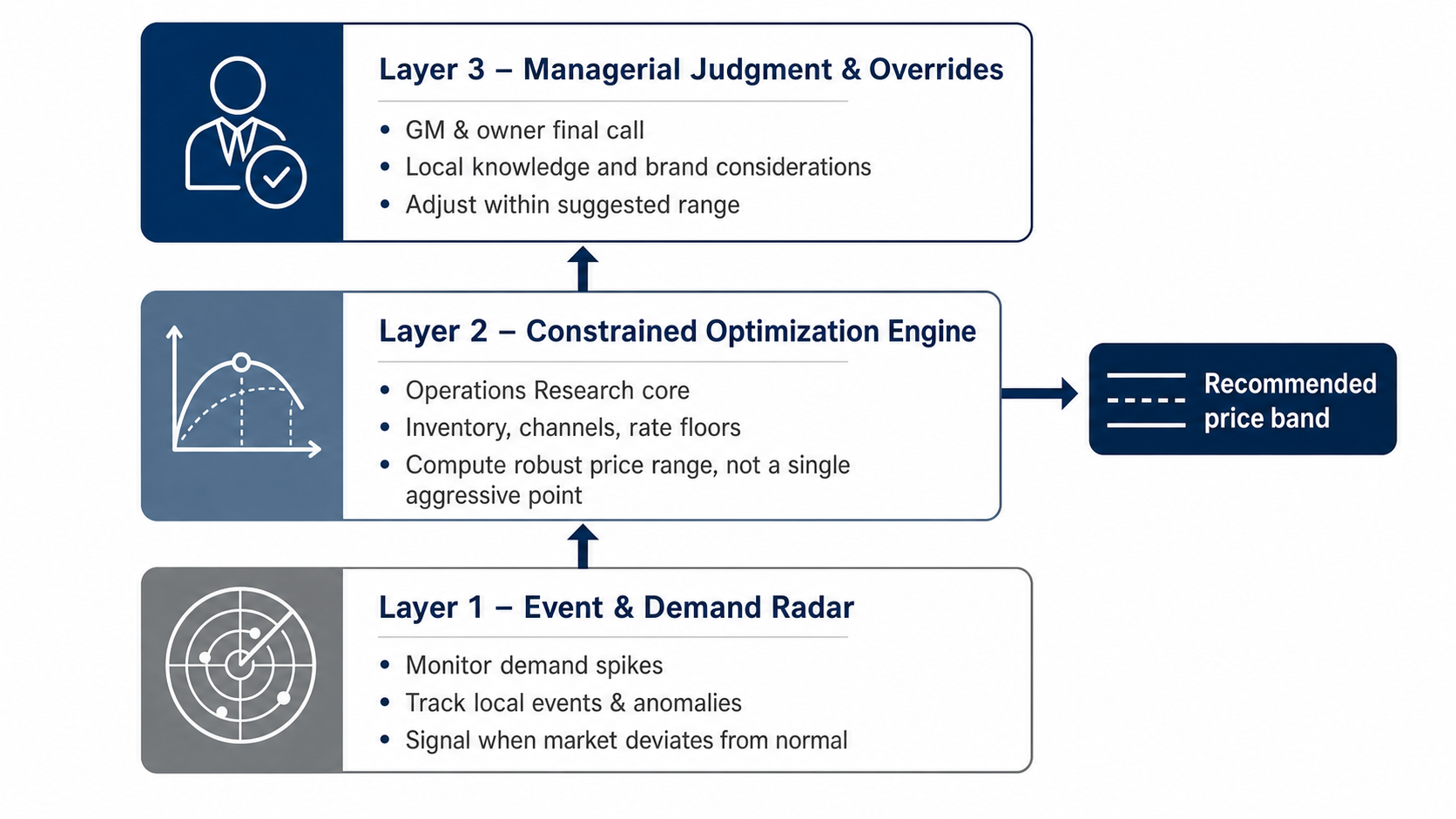 Fig. 1 — The Three-Layer Pricing Model
What a sound pricing model should follow
A truly effective room pricing optimization model should not treat AI as the entire answer. It should assign different roles to different parts of the system. A more credible architecture has three layers.
The first layer is an event and anomaly detection system. Its role is not to determine the final room rate directly, but to function as a market radar, constantly monitoring the signals that may alter the demand curve: abnormal pickup speed, major events, traffic changes, weather, policy disruption, and structural movement in the competitive set. Its purpose is not merely to answer “what should today's price be,” but to answer the deeper question: “has today's market moved away from normal conditions, and does it now require a different pricing posture?”
The second layer is a constraint-based optimization engine grounded in operations research. This is the true core of room price optimization. It must work within inventory, channel structure, rate floors, occupancy targets, customer segmentation, booking windows, and price elasticity constraints to identify the most effective price range for RevPAR and total revenue performance. The goal should not be an aggressive point estimate without boundaries, but a feasible and commercially sound interval that improves returns while keeping risk under control.
The third layer is the preservation of managerial judgment in the final mile. Hotels are not standardized production lines; they are local operating systems filled with partial knowledge, relationship effects, and immediate contextual awareness. Experienced general managers, owners, and revenue leaders often know things the system cannot fully capture in time: temporary roadwork, shifting local demand sentiment, unusual account behavior, or soft signals emerging at property level. A mature system should therefore not demand unconditional compliance. It should provide a strong baseline and then leave room for rational managerial adjustment.
Why a more pragmatic model works better
From both an engineering and a commercial standpoint, the most sustainable product is not the one that promises perfect precision for every hotel. It is the one that solves roughly 70 percent of the common problem at industrial scale, and then deliberately leaves the remaining non-standard variation to local knowledge and managerial judgment. This is not a compromise. It is a disciplined acknowledgment of statistical limits, market complexity, and the operational reality of hospitality.
A strong common model, trained on broad multi-market and multi-cycle patterns, can provide a stable baseline for a large number of hotels. The remaining regional differences, property-level nuances, and event-specific deviations can then be handled through localization logic, segmented demand interpretation, and controlled human override. This approach avoids the slow heaviness of older enterprise systems while also avoiding the hidden risk of fully automated black-box pricing.
For most hotel executives, the genuinely valuable system is not one that demands obedience. It is one that saves analytical time, offers a trustworthy baseline, and expands pricing power when important events create real upside. If a model can consistently handle 70 to 80 percent of daily pricing work, keep recommendations within a high-quality practical range, and then return the final adjustment authority to the operator, it is already much closer to commercial effectiveness than many of the market's more dramatic automation narratives.
What productization should look like
Based on that understanding, the right product form should not aim to replace people altogether. It should build a lightweight, transparent, and interpretable optimization framework. It should deploy quickly, avoid unnecessary disruption to the hotel's existing systems, and translate complex calculations into recommendations that decision-makers can actually understand and use. Most importantly, it must explain why a certain rate is being recommended, so that pricing decisions can be validated, reviewed, and refined over time.
Beyond that, localization should be a core capability rather than a secondary feature. Hotels in different cities, different market tiers, and different demand structures should not be forced into a single undifferentiated global template. A genuinely effective model must recognize that every destination has its own rhythm, every segment has its own elasticity profile, and every event affects properties differently. The strength of the product lies not in glorifying a universal algorithm, but in building a strong common base and then sharpening its understanding of specific markets, segments, and scenarios.
Closing perspective
For hotel executives and senior industry leaders, the key strategic question today is not how many new pricing buzzwords the market can produce. The more important question is how hotel room optimization should be modeled seriously. The answer is straightforward: a useful model should use event detection as its forward radar, operations research as its optimization core, and managerial judgment as a necessary boundary condition. It should seek stability, interpretability, and execution quality rather than the illusion of total automation.
Hotel revenue management has never been an industry where the loudest AI narrative wins in the long run. It is an industry that ultimately returns to ledger results, organizational trust, and operational reality. The models that endure will not be the ones that sound the most revolutionary, but the ones that truly understand price elasticity, event-driven demand, local market differences, and the enduring value of experienced human judgment.
回到模型本身:酒店房价最优化到底应该如何设计
作者:殷彤博士(Dr. Tong Yin) · InsightBridge Global LLC — 定价架构与经营纪律
在今天的酒店科技市场里,关于收益管理和房价优化的讨论,常常被包装成一场“算法能力”的竞争:是深度学习更先进,还是强化学习更聪明,或者是否能够做到每小时自动调价。可对于真正对利润表、现金流和经营风险负责的酒店高管而言,问题从来不是某个系统听起来有多前沿,而是它是否能够在复杂、波动、充满约束的现实经营环境中,持续、稳健、可控地帮助酒店提升收益。
这也是为什么,讨论现代酒店房价最优化模型,不能从技术营销话术出发,而必须从问题本身出发。酒店定价不是一个抽象的数学游戏,更不是一个脱离现场的自动化演示。它是一个高度现实的经营决策问题:一方面需要在有限库存、渠道结构、品牌要求和市场波动之间找到收益最大化的平衡点;另一方面又必须承认,任何酒店都处于具体城市、具体商圈、具体客群结构与具体事件冲击之中,不可能完全依赖一个脱离语境的黑箱系统来决定价格。
当前市场上的几种典型思路
从方法论上看,目前市场上的房价优化产品大体可归纳为三类。第一类是以长期历史数据和批量预测为核心的传统体系,依靠多年行业样本、季节性规律和既有规则体系,提供相对稳健的价格建议。这类体系的优势在于稳定、成熟、工程化程度高,但也往往较重、较慢,对本地化细节和非标准个体酒店的适应能力有限。
第二类是近几年更受关注的“全自动 AI 定价”路线。这类产品通常强调自学习、自动驾驶、高频动态调价,以及极高的建议采纳率,试图向市场传达一个印象:系统可以凭借算法自行学习每一家酒店的最优价格,不再依赖人为规则或行业经验。第三类则是规则引擎加人工微调的混合模式,系统完成基础计算与建议,人类保留较大的调价和覆盖空间。虽然这种模式在市场叙事中不如“全自动 AI”吸引眼球,但它更接近绝大多数酒店真实的工作方式。
目前的关键问题
真正的问题不在于市场上有没有产品,而在于不少产品在建模逻辑上偏离了酒店经营的第一性原理。首先,一些系统把高频调价本身当成能力的证明,仿佛价格改得越频繁,模型就越先进。但在绝大多数没有重大事件、没有需求突变、没有显著供需失衡的平稳日子里,高频改价并不会创造新的收益,反而可能带来渠道噪音、执行混乱以及管理者对系统的疲劳感。
酒店真正的超额利润,并不是来自平静时期对价格做几块钱、几美元级别的机械波动,而是来自对关键事件和需求激增窗口的识别与把握。当演唱会、展会、区域交通变化、政策波动、天气异常或大型团体活动改变了真实需求曲线时,价格策略才真正进入可以创造显著收益差异的区间。也就是说,优秀模型的第一任务不是“天天动”,而是“在真正该动的时候,提前、准确、稳健地动”。
第二个问题,是把建议“被接受”误当成模型有效。表面上看,建议采纳率似乎是一个很漂亮的指标;但在真实经营中,管理者并不一定会专门去点击“拒绝”某个建议,也完全可能只是把系统建议当作一个参考,然后直接根据现场认知做手动微调。于是,一个很高的采纳率未必意味着模型很准,它也可能只是意味着系统被设成了默认执行,或者用户把它当作基础参考后自行调整。
第三个问题,是过度相信“单店自学习”的神话。对于大量单体酒店、中小酒店集团乃至区域性运营主体来说,单家酒店能够提供的数据体量、事件样本和价格反馈样本是有限的。仅靠单个酒店自身的交易数据,要支撑真正稳定、广泛适用、对异常情况具有鲁棒性的复杂机器学习系统,在工程上并不现实。其结果往往是:平稳时期看似聪明,异常时期极易过拟合;日常时期似乎精细,关键时期反而失真。
第四个问题,是忽视了酒店定价的本质其实是一个带约束的优化问题。酒店并不是一个可以无限复制、无限试错的纯数字产品。它有固定库存,有不同渠道的销售结构,有最低价限制,有会员和协议价体系,有品牌与舆情的考虑,也有对入住率、平均房价和 RevPAR 之间平衡的现实要求。在这样一个多目标、多约束、非线性的环境里,单纯依赖黑箱式预测模型,而缺乏清晰的约束建模和优化框架,很容易在关键节点给出看似聪明、实则危险的建议。
Fig. 1 — The Three-Layer Pricing Model
房价最优化真正应遵循的原理
一个真正有效的酒店房价最优化模型,不应把“AI”当作全部答案,而应当把算法职责拆分清楚。更合理的设计,是由三个层次构成。
第一层,是事件与异常需求的识别系统。这个层次的作用不是直接决定最终价格,而是像雷达一样持续监测市场上那些会改变需求曲线的信号,包括预订速度的异常变化、重大活动、区域交通变化、天气、政策扰动以及竞品结构性变化。它解决的不是“每天价格多少”这样表面的问题,而是“今天的市场环境是否已经偏离常态、是否进入了一个值得重新定价的区间”。
第二层,是以运筹学为核心的带约束优化引擎。这一层才是真正的“房价最优化”主体。它需要在库存、渠道、价格底线、目标入住率、价格弹性、不同客群结构和预订窗口等约束条件下,寻找能够提升 RevPAR 和总收益的最优价格区间。这里的核心不应是无边界地追求激进点值,而是通过约束优化找到一个现实中可执行、风险可控、收益更优的区间解。
第三层,是保留人类经营判断的最后一公里机制。酒店不是标准化零件工厂,而是一个充满局部知识、关系网络和即时感知的行业。经验丰富的总经理、业主或收益负责人,常常知道一些系统暂时无法完全捕捉的信息,例如临时施工、客源结构变化、地面渠道情绪、某个本地客户关系的特殊性等。因此,成熟的系统不应要求管理者“无条件接受”某个价格,而应该在稳健基准之上,允许并鼓励合理微调。
为什么更务实的模型更有效
从工程和商业的角度看,真正可持续的产品,不是承诺对每一家酒店都做到绝对精准,而是在工业化规模上先解决 70% 左右的共性问题,再把剩余的非标准差异留给本地经验与管理判断去完成。这不是妥协,而是对统计学边界、行业复杂性和酒店经营现实的尊重。一个统一的强底座模型,基于跨区域、跨周期的大样本规律,可以为大量酒店提供稳定的基础建议;而地区差异、物业差异和事件差异所产生的剩余部分,则通过本地化参数、细分市场逻辑和人工微调机制来弥补。
这种思路的意义在于,它既避免了传统重系统部署缓慢、操作过重的问题,也避免了“全自动黑箱”对单店经营者造成的风险。对于多数酒店高管来说,真正有价值的不是一个要求绝对服从的系统,而是一个能节省大量分析时间、提供可信基准、并在关键事件来临时及时提醒和放大利润机会的系统。如果一个模型能够把日常 70% 到 80% 的基础判断稳定做好,把价格建议控制在一个高质量的合理区间内,再把最后的局部修正权交还给经营者,那么它就已经比大量市场叙事中的“全自动神话”更接近真实有效。
产品应该怎样落地
基于这样的理解,更合理的产品形态不应该是追求“全面替代人”,而应该是建设一个轻量、透明、可解释的收益优化框架。它首先要能够快速部署,尽量减少对酒店现有系统架构的大规模改造;其次要能够把复杂运算结果转化为管理层每天真正能读懂、能执行的建议;最后,它必须把“为什么今天建议这样定价”解释清楚,让价格建议可以被验证、被复盘、被修正。
更进一步,这类产品应当把本地化作为核心能力,而不是附加选项。不同城市、不同档次、不同客源结构的酒店,不应被简单塞进一个没有差别的全球模板中。真正有效的模型,必须承认每一个目的地都有自己的规律,每一个市场分层都有自己的弹性曲线,每一类事件对不同酒店产生的影响也并不相同。因此,好的产品不是把“统一算法”神化,而是在统一底座之上,持续增强对特定市场、特定级别酒店和特定场景的理解能力。
结语
对于酒店高管和行业管理者而言,今天真正值得重新思考的,不是市场上又多了多少新名词,而是房价最优化这件事到底应该如何被严肃地建模。答案并不复杂:真正有效的模型,应当以事件识别为前哨、以运筹学优化为核心、以人类判断为边界条件;应当追求稳健、可解释、可执行,而不是追求听上去无所不能的自动化叙事。
酒店收益管理从来不是一个“谁更会讲 AI 故事”的行业,而是一个最终必须回到账面结果、组织信任和经营现实的行业。能够长期有效的,不会是最喧哗的系统,而是那些真正理解价格弹性、理解事件驱动、理解本地差异、也理解管理者判断价值的模型。
Get the InsightBridge Weekly Brief — free in your inbox
One email a week — distilling the hotel, AI, geopolitical, and macro decisions and analysis that actually matter to executives. Completely free. No noise. Unsubscribe anytime.
Discussion (0)
Related reading
Three Paths to AI Commercialization: Aligning Position, Capital, and Target Market
For most companies the central AI question is not how to reach the technical frontier, but which commercial architecture they can realistically sustain. This note distinguishes three commercialization paths now visible in the global market — the capital-intensive frontier bet, the ecosystem-embedded utility, and the B2B technical wholesale — and the geopolitical and unit-economic constraints that quietly determine which path is open to whom.

The Boundaries and Humility of Strategy: Rethinking Cross-Sector Investment in an Era of Reversal
In an era of violent reversal, how should an enterprise formulate its strategy? Using New Oriental's pivot from after-school education into cultural tourism as a mirror — not to judge, but to illuminate the principles too often overlooked. Five disciplines: capability over tailwind; respect for the asset-structure of the value chain; reverence for common sense; ambition matched to true market capacity; and grayscale testing as the guardrail that lets ambition travel far. Strategy returns from grand narrative to core capability and the humility to correct course.

Tourism & Hotel Industry Morning Briefing — Issue #55 · June 14, 2026
Issue #55 of the InsightBridge morning briefing. Trump cancels Iran strikes — Brent crude falls to $87.25; Gulf hotel recovery hinges on weekend MoU. Bank of Japan rate hike to 1.0% locked in for June 16; departure tax triples July 1. U.S. RevPAR forecast upgraded to +2.8–3.0%. Marriott hits 10,000 properties; India is the global hospitality bet of 2026–2030. GCC pipeline at all-time high — 103 hotels open in 2026. APEC Tourism Ministerial in Macau June 24–28. HITEC 2026 opens June 15.